
The landing page vs website question usually comes up when a business is about to spend money: launching a product, running ads or finally getting online. Both are web pages, but they do different jobs. This guide defines each one, breaks down what goes into them and gives clear verdicts for eight common business scenarios, so you can build the right thing first.
Quick answer: A landing page is a single page built for one conversion goal, usually for a campaign. A website is a multi-page home for your whole business. Choose a landing page to test an idea, run ads or capture leads for one offer. Choose a website for credibility, search visibility and multiple services. Most growing businesses need both.
On this page
- Key takeaways
- What is the difference between a landing page and a website?
- What does a high-converting landing page include?
- What does an effective business website include?
- Landing page vs website: 8 business scenarios and verdicts
- When should you use both a landing page and a website?
- How much do landing pages and websites cost?
- What are the most common landing page and website mistakes?
- Frequently asked questions
- Next steps
Key takeaways
- A landing page focuses on one audience, one offer and one action; a website serves many audiences, questions and goals.
- Landing pages excel at paid campaigns, launches, events and lead magnets because they remove distractions.
- Websites excel at building trust, ranking in search and supporting customers through longer buying journeys.
- Sending ad traffic to your home page is one of the most common and costly mistakes; give each major campaign a matching landing page.
- You rarely have to settle the landing page vs website question forever: the strongest setup for most businesses is a solid website as the hub, with campaign landing pages as spokes.
What is the difference between a landing page and a website?
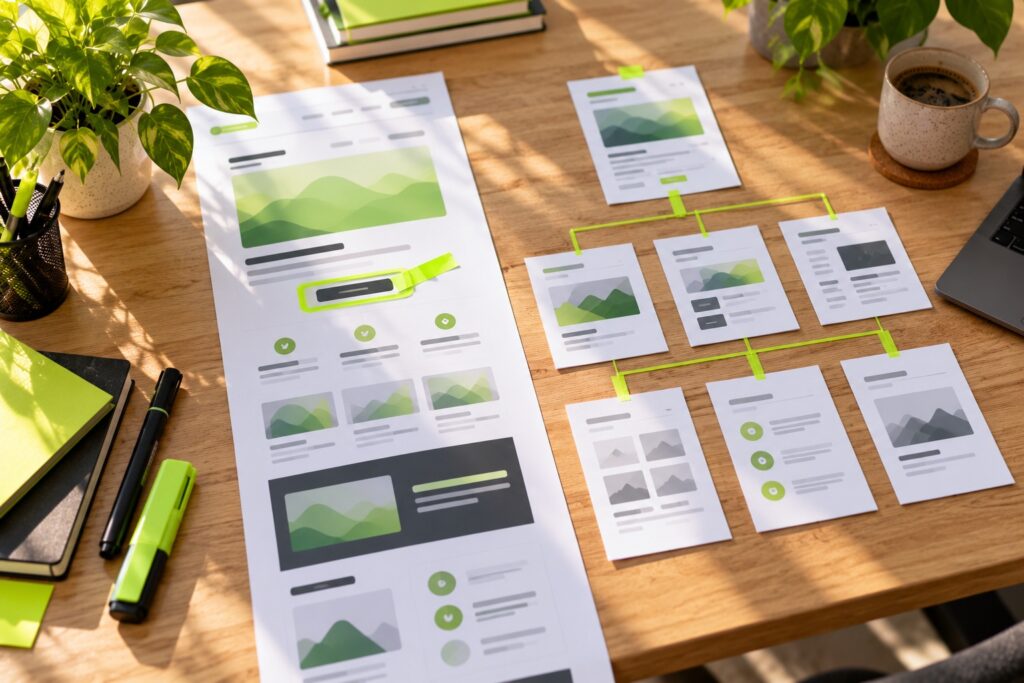
The difference is focus. A landing page is one page designed to get one specific action from one specific audience, while a website is a connected set of pages that explains who you are, what you offer and how to work with you.
What is a landing page?
A landing page is a standalone web page that visitors “land” on after clicking an ad, email, social post or QR code, built around a single conversion goal such as booking a demo, claiming an offer or downloading a guide. It usually has little or no main navigation, so the only obvious next step is the call to action.
What is a website?
A website is a collection of interlinked pages under one domain, typically including a home page, service or product pages, an about page, a contact page and often a blog. It supports many goals at once: informing, reassuring, ranking in search engines, answering support questions and generating leads or sales.
Is a home page a landing page?
Technically, any page where a visitor arrives is a “landing page” in analytics tools. In marketing, though, the term means a purpose-built, single-goal page. A home page is the opposite: it must serve new visitors, returning customers, job seekers and partners, so it can’t focus on one offer.
What about one-page websites?
A one-page website puts a business’s essential information (services, proof, contact) on a single scrolling page. It sits between the two: broader than a landing page but far more limited than a full website, especially for search visibility, because one page can only target a narrow set of topics.
| Factor | Landing page | Website |
|---|---|---|
| Purpose | One conversion goal | Many goals across the customer journey |
| Number of pages | One | Several to hundreds |
| Navigation | Minimal or none | Full menus, footer links, internal links |
| Main traffic sources | Ads, email, social, QR codes | Search, direct, referrals, social, ads |
| Lifespan | Often weeks or months | Years, with ongoing updates |
| SEO role | Limited; often excluded from search for ad-only variants | Core asset for organic visibility |
| Typical build time | Days to a couple of weeks | Weeks to months |
| Success metric | Conversion rate for one action | Leads, sales, engagement and visibility overall |
What does a high-converting landing page include?
A high-converting landing page includes a focused headline, a clear offer, proof, a single call to action and as little distraction as possible. Here is the typical anatomy from top to bottom:
- Headline that matches the source. If the ad promises “Same-day AC repair,” the headline should say the same thing. This message match reassures visitors they’re in the right place.
- Supporting subheadline. One or two lines explaining who it’s for and the main benefit.
- Hero visual. A product shot, short video or image of the outcome, not a generic stock photo.
- Primary call to action (CTA). One action, repeated down the page: “Book your free consultation,” “Get the guide,” “Start your trial.”
- Benefits, not features. Three to five scannable points explaining what the visitor gains.
- Social proof. Reviews, ratings, client logos or short testimonials, with permission to use them.
- Objection handling. A short FAQ covering price, timing, guarantees and what happens next.
- A short form or simple checkout. Ask only for what you need now; every extra field adds friction.
- Trust signals. Security badges near payment, a privacy link near the form, real contact details.
- Minimal exits. No full menu, few outbound links and a slim footer with legal links.
Landing page quality also affects ad costs. According to Google Ads Help, landing page experience is one of the three components of Quality Score for Search campaigns, alongside expected click-through rate and ad relevance.
What does an effective business website include?
An effective business website includes the pages, structure and technical foundations needed to inform, reassure and convert many kinds of visitors over time. It has to answer every reasonable question a prospect might ask before contacting you.
Core components:
- Home page that explains what you do, who you serve and where to go next.
- Service or product pages, ideally one page per main offer, so each can rank and convert on its own.
- About page with your story, team and credentials.
- Proof in the form of reviews, case studies or portfolio work.
- Contact page with multiple ways to reach you, plus location details if relevant.
- Helpful content such as a blog, guides or FAQs that attract search traffic.
- Legal pages like a privacy policy and terms.
- Technical foundations: fast loading, mobile-friendly layouts, analytics, clean URLs and a sitemap.
For a page-by-page breakdown, see our guide to the must-have pages on a small business website. Google’s SEO Starter Guide is also a useful primer on how search engines discover and understand a multi-page site.
Landing page vs website: 8 business scenarios and verdicts
The right choice depends on your goal, traffic source, timeline and budget. Each scenario below is hypothetical but reflects situations businesses face constantly, with a verdict and a recommended build.
Scenario 1: You’re validating a new product idea
Situation: A hypothetical founder wants to test demand for a meal-planning app before writing code.
Verdict: Landing page.
Why: You need speed and a clear signal (sign-ups or pre-orders), not a full brand presence. A focused page plus a small ad budget shows whether people care before you invest more.
What to build: One page with the problem, the promised outcome, a mockup and a waitlist form. Track conversion rate by traffic source.
Scenario 2: You’re a local service business that wants calls from Google
Situation: A hypothetical plumbing company wants to show up in Google Maps and local search results for several services across nearby towns.
Verdict: Website.
Why: Local search visibility depends on relevant pages for each service and area, consistent business details and trust signals. A single landing page can’t rank for “water heater repair,” “drain cleaning” and “emergency plumber” in several towns at once.
What to build: A website with individual service pages, a service-area page and a strong contact page, following a local SEO checklist. Add landing pages later if you run ads.
Scenario 3: You’re running paid ads for a specific offer
Situation: A business is launching search and social ads for a spring discount on one service.
Verdict: Landing page (on your own domain).
Why: Ads convert better when the page matches the ad’s promise exactly and removes distractions. Your home page forces visitors to hunt for the offer.
What to build: One landing page per offer or audience, with headline, offer details, proof and a single form. If you’re still deciding where to advertise, compare Google Ads vs Meta Ads, since search and social traffic often need different page angles.
Scenario 4: You’re promoting an event, webinar or course
Situation: A training company is running a live webinar with a fixed date and limited seats.
Verdict: Landing page.
Why: Event promotions are time-bound and single-goal: register before the date. A dedicated page with the agenda, speaker details and a short form is all you need.
What to build: A registration page with date, time zone, what attendees will learn and a countdown or deadline message, plus a thank-you page that confirms the booking.
Scenario 5: You’re a B2B company with several services and long sales cycles
Situation: A hypothetical IT services firm sells managed support, cybersecurity and cloud migration to mid-sized companies, and deals take months.
Verdict: Both: a full website plus campaign landing pages.
Why: Buyers research extensively, compare providers and involve several decision-makers. They need depth (case studies, service detail, team credentials) that only a website provides. Campaigns for specific offers, such as a free security assessment, still perform best on focused landing pages.
What to build: A website with detailed service pages and proof, plus landing pages for each campaign, gated guide or event.
Scenario 6: You’re a freelancer or consultant with one core offer
Situation: A hypothetical brand strategist sells one package and has a limited budget.
Verdict: Start with a one-page site, then grow into a website.
Why: One offer and a small budget make a focused page sensible. But a single page limits search visibility and room for case studies, so plan to add service, portfolio and blog pages as the business grows.
What to build: A one-page site with offer, process, testimonials, a short bio and a booking link, built on a platform that lets you add pages easily later.
Scenario 7: You’re a restaurant, clinic or multi-location business
Situation: A business with several locations needs to share menus or services, opening hours, booking options and directions.
Verdict: Website.
Why: Visitors arrive with many different questions, and each location benefits from its own page with accurate details. That needs structure and navigation that a landing page deliberately removes.
What to build: A website with a page per location, clear service or menu pages, online booking and consistent contact details everywhere.
Scenario 8: You’re growing an email list with a free resource
Situation: A business offers a free checklist or guide in exchange for an email address.
Verdict: Landing page.
Why: Lead magnets have one goal: the sign-up. Removing navigation and focusing on the value of the resource is exactly what landing pages are built for.
What to build: A short page with a preview of the resource, three key benefits, a one- or two-field form and a thank-you page that delivers the download.
Scenario verdicts at a glance
Here is every landing page vs website verdict from this section in one table.
| Scenario | Verdict |
|---|---|
| Validating a new product idea | Landing page |
| Local service business wanting search visibility | Website |
| Paid ads for a specific offer | Landing page on your domain |
| Event, webinar or course launch | Landing page |
| B2B company with several services | Both |
| Freelancer with one core offer | One-page site, then a website |
| Restaurant, clinic or multi-location business | Website |
| Email list growth with a free resource | Landing page |
When should you use both a landing page and a website?
You should use both once you run campaigns and also need a lasting presence, which describes most growing businesses. The website acts as the hub for credibility and organic search, while landing pages act as spokes for individual campaigns, offers and audiences.
How to make them work together:
- Host landing pages on your own domain (for example, yourdomain.com/offer) or a subdomain so they benefit from brand trust and are easier to track.
- Keep branding consistent. Visitors who later check your website should recognize the same company.
- Decide what search engines should see. Short-lived, ad-only variants are often set to noindex to avoid near-duplicate pages, while evergreen offers can be optimized to rank.
- Tag every campaign link with UTM parameters and track conversions properly; our guide to GA4 for beginners explains the setup.
- Build a landing page library. Reusable templates make new campaigns faster and keep quality consistent.
- Retire pages cleanly. When a campaign ends, redirect the page to a relevant evergreen page instead of leaving a dead end.
When you budget for both, plan for ongoing landing page testing as part of your marketing spend rather than a one-off design cost. Our guide on how to set a realistic digital marketing budget covers how to split money between always-on assets and campaigns.
How much do landing pages and websites cost?
A landing page generally costs far less than a website because it is one page with one goal. On cost alone, the landing page vs website comparison is lopsided, but remember that the two do different jobs. The ranges below are typical estimates that vary by market, provider and complexity.
| Option | Typical cost range | Typical timeline |
|---|---|---|
| DIY landing page with a builder | Builder subscription, often tens to a few hundred dollars per month | Days |
| Professionally designed landing page | $500–$5,000+ per page | 1–3 weeks |
| One-page website | $1,000–$5,000+ | 1–3 weeks |
| Small business website (5–15 pages) | $3,000–$20,000+ | 4–12 weeks |
| Larger custom website | $20,000–$100,000+ | 3–6+ months |
For a detailed breakdown of what drives website pricing, read our guide on how much a website costs.
What are the most common landing page and website mistakes?
The most common mistakes come from using one tool for the other’s job. Watch for these:
- Sending ad traffic to the home page. Visitors must hunt for the offer, and many leave.
- Leaving full navigation on a landing page. Every menu link is an exit from your campaign.
- Relying on a one-page site for a multi-service business. You limit search visibility and make it harder to explain each service in depth.
- Mismatched messaging. An ad promising a discount that the page never mentions erodes trust instantly.
- Too many CTAs. Asking visitors to call, subscribe, follow and buy on one landing page dilutes the main action.
- No measurement. Without conversion tracking, you can’t tell which page or campaign is working.
To push results further once the basics are right, work through these conversion rate optimization tips and test one change at a time.
Frequently asked questions
Can a landing page replace a website?
For a short time and a narrow purpose, yes, such as validating an idea or running one campaign. Long term, most businesses outgrow it. A single page struggles to rank for multiple searches, explain several services or build enough trust for larger purchases, so treat a standalone landing page as a starting point, not a permanent home.
Is a landing page good for SEO?
A landing page can rank for one focused topic if it has substantial, useful content, but it’s not built for broad SEO. Websites rank better overall because they cover many topics across many pages and earn internal and external links. Many ad-only landing pages are deliberately kept out of search results.
Should Google Ads go to a landing page or a home page?
In most cases, send Google Ads traffic to a dedicated landing page that matches the ad’s keyword and promise. Google Ads Help lists landing page experience as a component of Quality Score, and a focused, relevant page usually converts better than a general home page that serves many audiences.
How many landing pages should a business have?
There’s no fixed number. A common approach is one landing page per distinct offer, audience or campaign, because message match drives results. A small business might start with two or three, while companies running many campaigns may maintain dozens, ideally built from shared templates to keep quality consistent.
What is the difference between a landing page and a one-page website?
A landing page focuses on one offer and one action, usually for a specific campaign, with minimal navigation. A one-page website summarizes an entire business, including services, about, proof and contact, on a single scrolling page. The one-page site is broader in scope but still far more limited than a multi-page website.
Can I build landing pages on my existing website platform?
Usually, yes. Most modern website platforms let you create pages without the main navigation, use custom templates and add forms, so landing pages can live on your domain. Dedicated landing page builders add extras like fast A/B testing and template libraries, which help if you launch campaigns frequently.